
 Practice Test
 Question Bank
 Vocab 600
 Pricing
 Test Info
SAT Overview
Test Structure
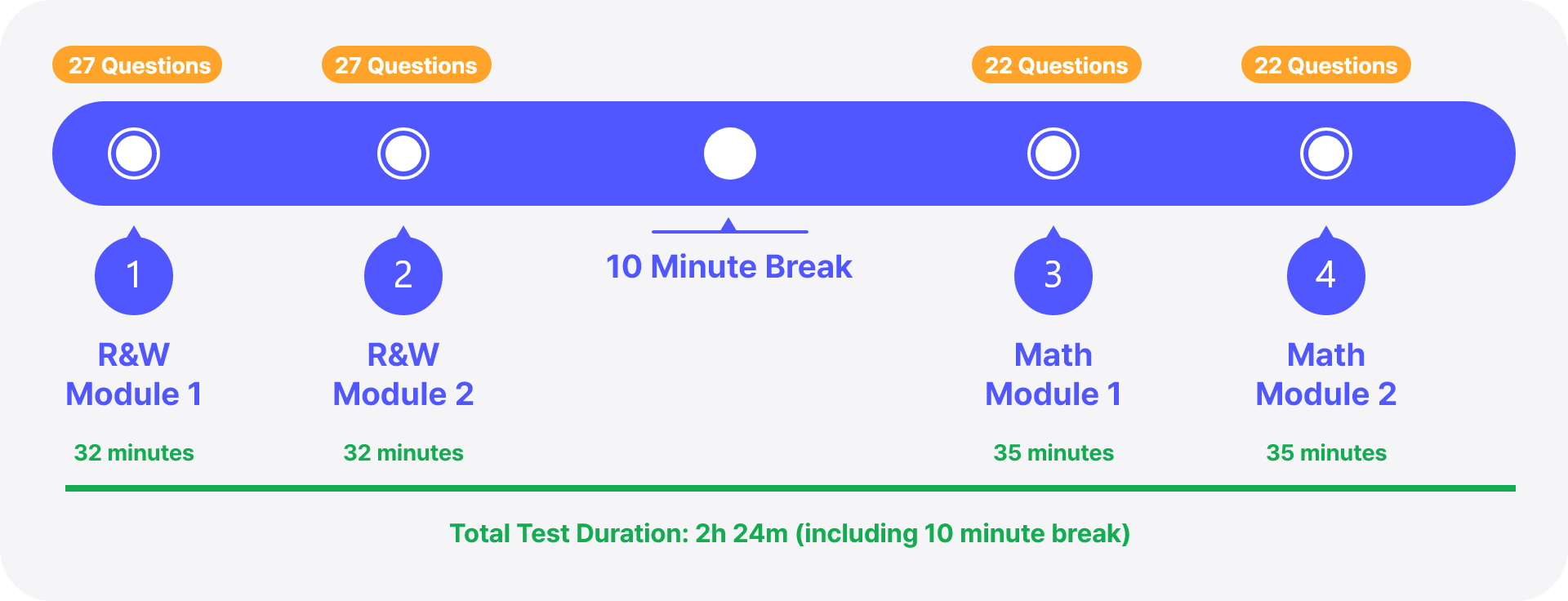
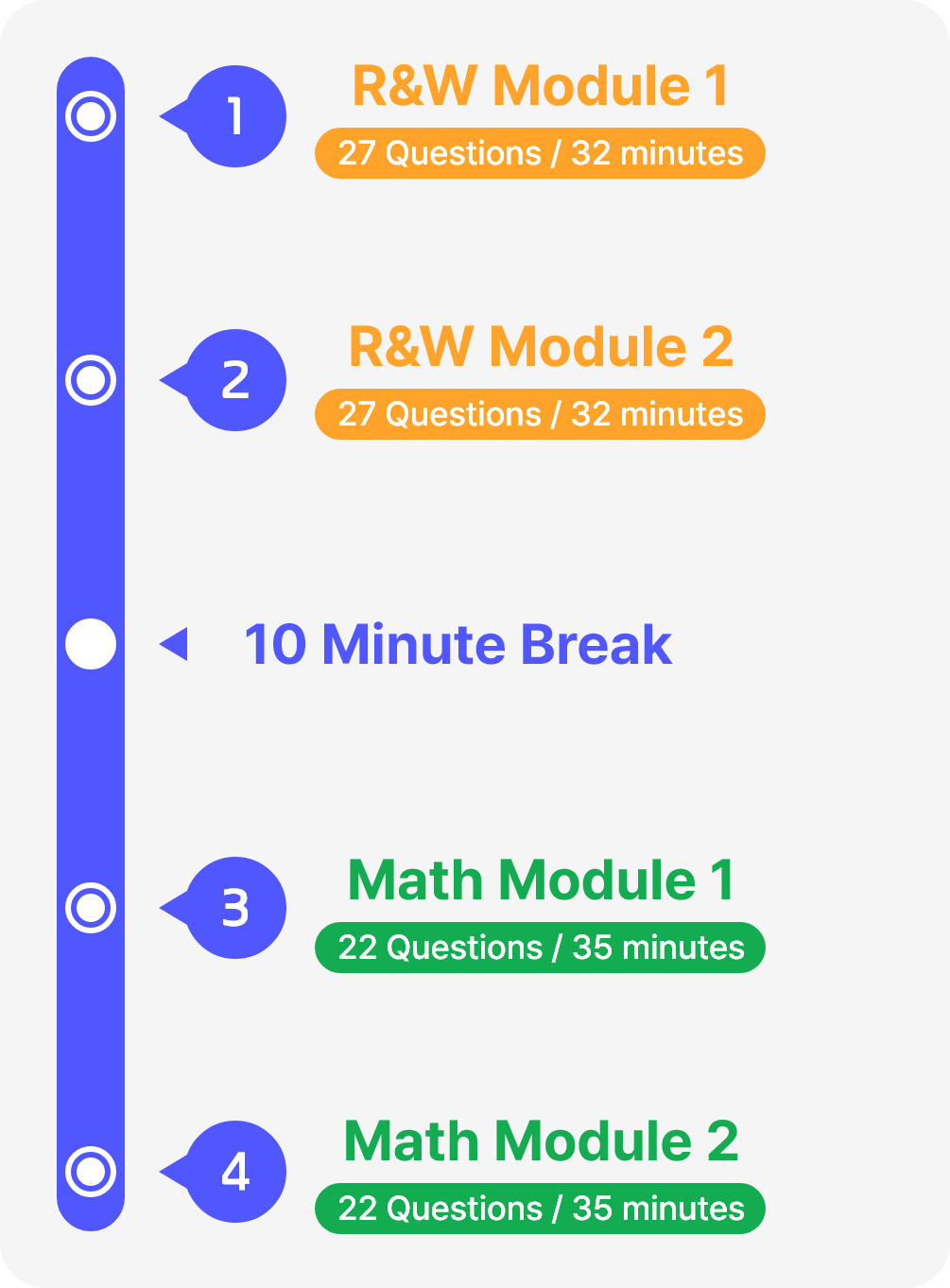
The SAT consists of a Reading and Writing section and a Math section, each composed of 2 modules (4 modules in total). The test proceeds in the following order:
Scoring
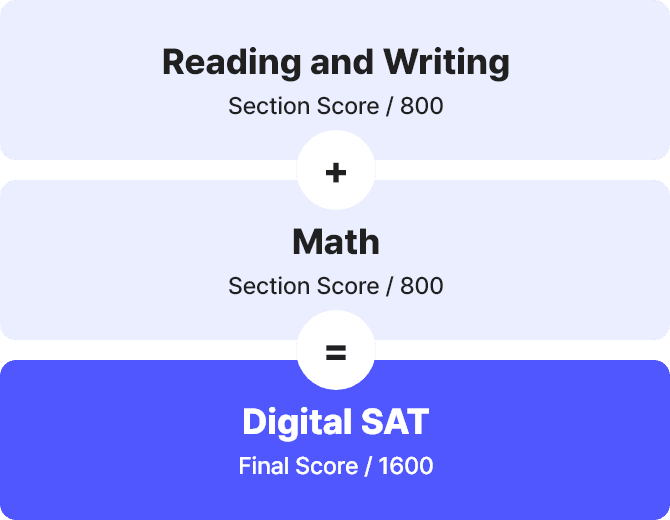
The final score of the SAT is calculated by adding the scores from the Reading and Writing section (out of 800 points) and the Math section (also out of 800 points) for a total maximum score of 1600 points. Since the SAT does not penalize for incorrect answers, it's always better to answer every question.

Reading and Writing Section
- Composed of 2 modules, each containing 27 questions to be answered within 32 minutes.
- Four-option multiple-choice questions only
- 11 question types distributed across 4 content domains
Content Domain
Craft and Structure
Question Type
①Words in Context
②Text Structure and Purpose
③Cross-Text Connections
Distribution
~28%
Content Domain
Information and Ideas
Question Type
④Central Ideas and Details
⑤Command of Textual Evidence
⑥Command of Quantitative Evidence
⑦Inferences
Distribution
~26%
Content Domain
Standard English
Conventions
Question Type
⑧Boundaries
⑨Form, Structure, and Sense
Distribution
~26%
Content Domain
Expression of Ideas
Question Type
⑩Transitions
⑪Rhetorical Synthesis
Distribution
~20%
Source: The SAT Suite of Assessments Specifications Overview (College Board)
-
The question types appear in order, from ① Words in Context to ⑪ Rhetorical Synthesis.
- Questions on ⑤ Command of Textual Evidence and ⑥ Command of Quantitative Evidence can appear in an alternating order.
- Questions on ⑧ Boundaries and ⑨ Form, Structure, and Sense can appear in an alternating order.
- Within the same question type, the questions are arranged from easiest to hardest.
Math Section
- Composed of 2 modules, each containing 22 questions to be answered within 35 minutes.
- Four-option multiple-choice (~75%) + Student-produced response (~25%)
- Various question types distributed across 4 content domains
Content Domain
Algebra
Question Type
Linear equations in one variable
Linear equations in two variables
Linear functions
Systems of two linear equations in two variables
Linear inequalities in one or two variables
Distribution
~35%
Content Domain
Advanced Math
Question Type
Equivalent expressions
Nonlinear equations in one variable and systems of equations in two variables
Nonlinear functions
Distribution
~35%
Content Domain
Problem Solving and
Data Analysis
Question Type
Ratios, rates, proportional relationships, and units
Percentages
One-variable data: distributions and measures of center and spread
Two-variable data: models and scatterplots
Probability and conditional probability
Inference from sample statistics and margin of error
Evaluating statistical claims: observational studies and experiments
Distribution
~15%
Content Domain
Geometry and
Trigonometry
Question Type
Area and volume
Lines, angles, and triangles
Right triangles and trigonometry
Circles
Distribution
~15%
Source: The SAT Suite of Assessments Specifications Overview (College Board)
- The types of questions appear randomly, with the number of questions for each type roughly matching the distribution.
- The questions are arranged from easiest to hardest.
- A built-in graphing calculator is available throughout the entire Math section (Students can also bring their own approved calculator).
Adaptive Testing
In the SAT, the difficulty of the second module in each section is determined by the results of the first module. If you score high in the first module, you will be given a more difficult second module. Conversely, if you score low in the first module, you will be given an easier second module. Keep in mind that if you receive an easier second module, the maximum achievable score will be lower.
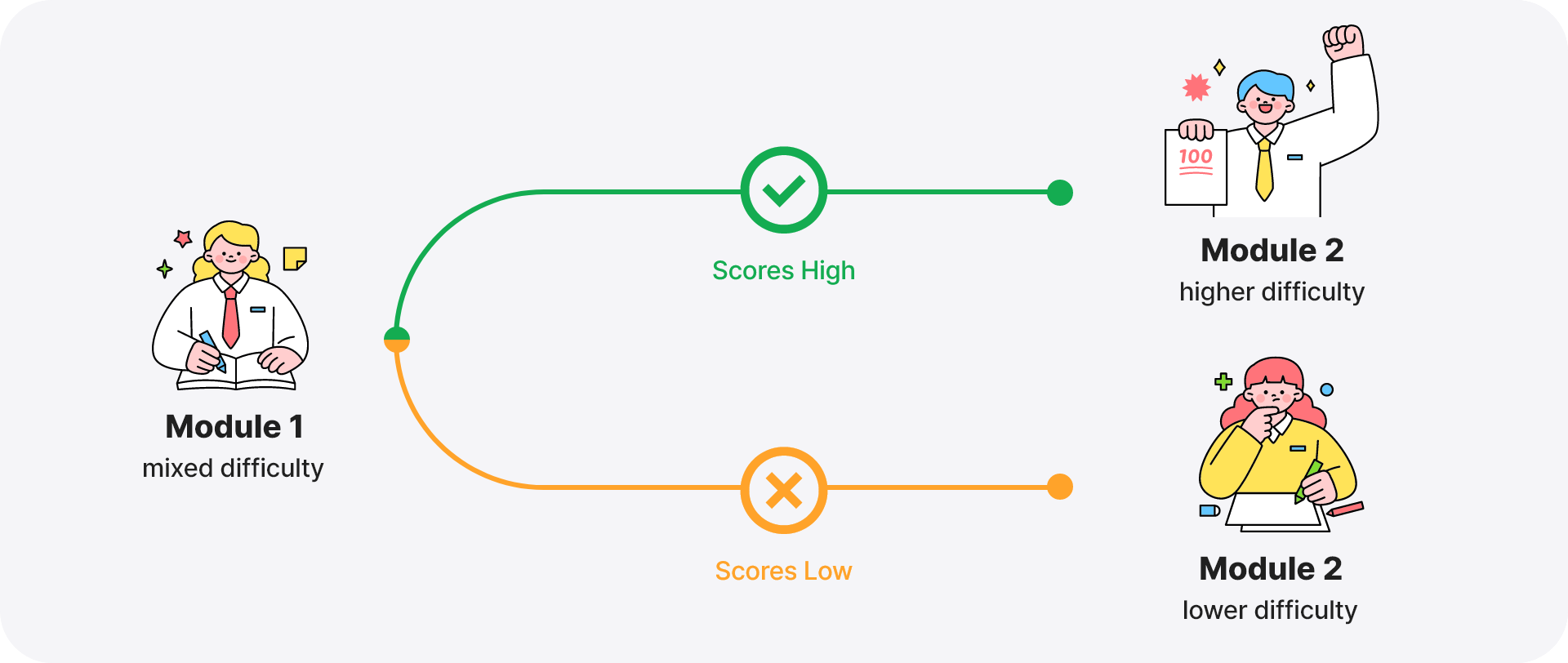
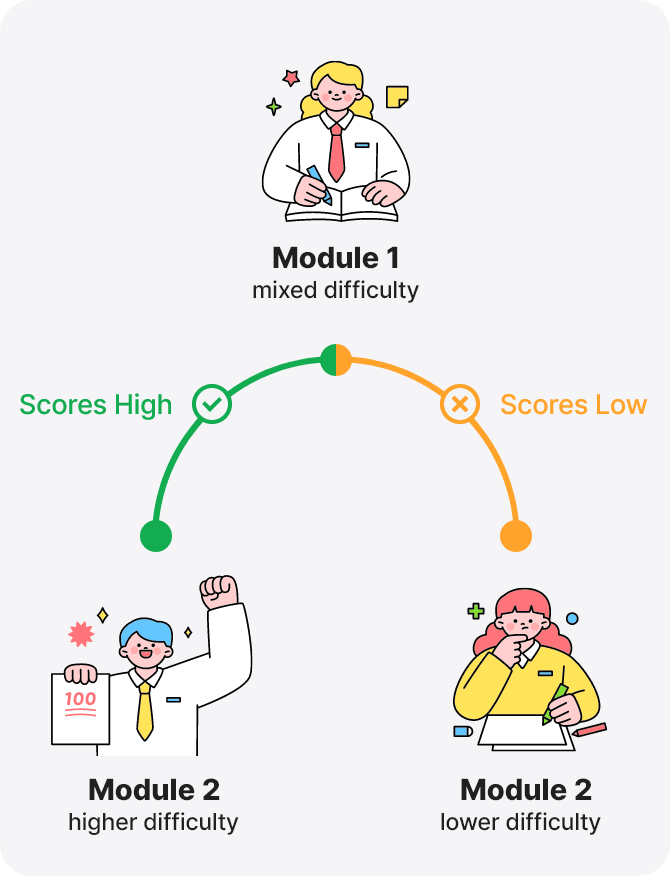
※ The diagram above is for illustrative purpose only.